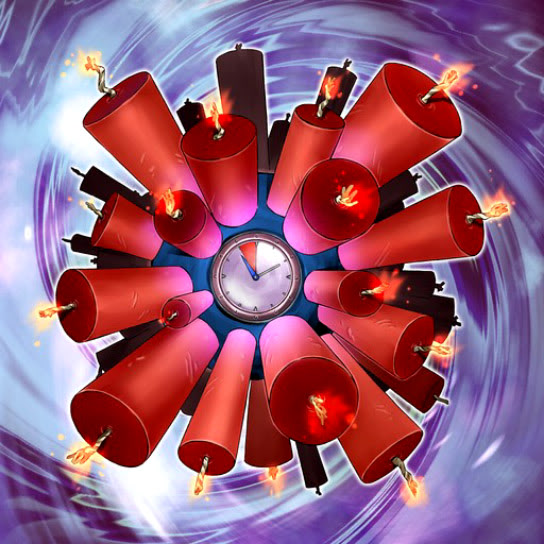
Deck Chain Burn #392413 — Yu-Gi-Oh! Master Duel
40 lá Main, 15 Extra, gồm Mahaama the Fairy Dragon x3, Chain Strike x3, Ceasefire x3.
Tạo bởi: YGO Mod (20517634)
Ngày tạo: Thứ Tư, 18 tháng 12 2024
Main Deck (40)
- Lava Golem x2
- Lord of the Heavenly Prison x2
- Michion, the Timelord x1
- Ghost Mourner & Moonlit Chill x1
- Mahaama the Fairy Dragon x3
- Chain Strike x3
- One Day of Peace x1
- Pot of Desires x1
- Pot of Extravagance x1
- Bad Luck Blast x2
- Boo-Boo Game x1
- Ceasefire x3
- Dimension Wall x3
- Gravedigger's Trap Hole x2
- Just Desserts x3
- Ring of Destruction x3
- Secret Barrel x3
- Secret Blast x3
- Trap Trick x2
Extra Deck (15)
- Combined Maneuver - Engage Zero! x1
- Dharc the Dark Charmer, Gloomy x1
- Hiita the Fire Charmer, Ablaze x1
- Lyna the Light Charmer, Lustrous x1
- Sky Striker Ace - Camellia x1
- Sky Striker Ace - Hayate x1
- Sky Striker Ace - Kaina x1
- Sky Striker Ace - Shizuku x1
- Sky Striker Ace - Zeke x1
- Blaze, Supreme Ruler of all Dragons x1
- Hieratic Dragon King of Atum x1
- Number 61: Volcasaurus x3
- Number C62: Neo Galaxy-Eyes Prime Photon Dragon x1
Không tải được deck
Deck — Đánh giá sức mạnh Deck
Final Contextual Deck Power: 63/100 (±5 · Confidence: Medium)
| Overall score | Value |
|---|---|
| Structural Deck Power | 62.35 |
| Going First | 58 |
| Going Second | 78 |
| Meta Power | provisional |
| Tournament Reliability | 65 |
- Primary strategy: Stun
- Secondary strategies: Toolbox
- Format: master-duel
Legality
Main 40 / Extra 15 / Side 0 — status: Legal.
Identity & game plan
- Win condition: Deal damage to opponent via burn traps and chain damage effects; Control board với removal and special summons
- Turn 1 (going first): Open với multiple damage traps (Secret Barrel, Secret Blast, Chain Strike) to inflict early burn; follow với Ring of Destruction or Lava Golem for board pressure.
- Turn 2 (going second): Use Dimension Wall and hand‑trap style damage cards to react to opponent's attacks while continuing burn; set up extra‑deck summons for additional pressure.
- Recovery: One Day of Peace for draw and damage pause; Pot of Desires/Extravagance for card advantage when needed.
- After siding: No side deck; relies on in‑deck flexibility and turn‑2 burn to close games.
Why it scores here
The deck reliably opens 1 burn engine, với 1 99.8% chance of having at least one core damage card in the opening hand, allowing consistent early damage. Its many independent trap effects give it solid interruption resilience and strong going‑second pressure, while limited draw resources keep the grind modest. Interaction quality is decent thanks to built‑in negation and removal, but the lack of 1 side deck and heavy reliance on hand cards lower flexibility and overall reliability.
Dimension scores
| # | Dimension | Score | Evidence |
|---|---|---|---|
| D1 | Engine Accessibility & Consistency | 90 | Archetype core group p_open_at_least_one_hand5 ≈ 0.998; 27 core copies (Suy luận) |
| D2 | Opening-Hand Quality & Brick Management | 80 | Full‑brick proxy probability 0.002; many duplicate damage traps may cause redundancy (Suy luận) |
| D3 | Combo Conversion & Ceiling | 65 | Potential to chain multiple burn traps (Secret Barrel, Secret Blast, Chain Strike) suggests 1 high ceiling, but no recorded combos (Suy luận) |
| D4 | Combo Floor & Median Output | 60 | Typical turn‑1 burn of ~2000‑3000 damage from common traps; median output moderate (Suy luận) |
| D5 | Interruption Resilience & Route Redundancy | 75 | Multiple independent damage sources and three negation‑text cards provide route redundancy (Suy luận) |
| D6 | Resource Economy, Recovery & Grind | 55 | Only one Limited draw engine (Pot of Desires) and One Day of Peace; limited recursion (Suy luận) |
| D7 | End-Board & Interaction Quality | 70 | Three cards với negation_text tags and nine removal_text cards give decent interaction density (Suy luận) |
| D8 | Going-Second & Board-Breaking Power | 80 | Going‑second hand size 6 với 99.8% core presence; burn traps react well to opponent's board (Suy luận) |
| D9 | Offensive Pressure & Closing Power | 70 | High ATK monsters (Lava Golem) and burn traps create strong closing pressure (Suy luận) |
| D10 | Main Deck Efficiency & Flexibility | 50 | 40‑card main deck với 19 distinct cards; 25 traps cause redundancy, lowering efficiency (Suy luận) |
| D11 | Extra Deck Efficiency & Coverage | 45 | 15‑card extra deck filled với many Sky Striker and Charmer links not central to burn plan (Suy luận) |
| D12 | Side Deck Adaptability | 30 | Side deck count 0; no post‑side adaptability (Suy luận) |
| D13 | Matchup Coverage & Format Fit | 40 | No tournament data; meta fit provisional (Tạm tính) |
| D14 | Pilotability & Error Tolerance | 70 | Straightforward trap activation sequence; moderate decision points (Suy luận) |
How the score was computed
Strategy profile: Stun. Structural ≈ 62.35, Đi trước ≈ 58, Đi sau ≈ 78, Meta = tạm tính, Độ tin cậy giải đấu ≈ 65. Điều chỉnh: No side deck (-4); High core consistency (6). Final formula: 0.80*Structural + 0.20*TournamentReliability (Meta provisional)
Probability & combo summary
- Opening 1 starter: P(≥1) ≈ 1 · key two-card combo ≈ — · full-brick estimate ≈ 0 (all Inferred)
- Combo output: best PowerIndex —, median —, board-per-starter —
- Turn order: 0 going-first lines vs 0 going-second lines
Strengths
- Extremely high opening‑hand consistency for burn engine
- Multiple independent damage sources give strong going‑second pressure
- Decent interaction via negation and removal cards
Weaknesses
- Limited draw and recursion resources
- No side deck reduces adaptability
- Heavy reliance on hand traps can cause variance if draws are poor
Critical choke points
- Opening hand lacking any damage trap (very rare but possible)
- Running out of burn traps vớiout draw power
Recommended changes
| Priority | Remove | Add | Reason |
|---|---|---|---|
| 1 | Some duplicate Sky Striker links | Additional hand traps (e.g., Infinite Impermanence) for extra control | Improve side‑deck adaptability and defensive options |
Evidence & confidence
- Verified: legality status Legal; card copy limits from legality; probabilities hypergeometric table
- Inferred: engine accessibility from nhóm lá cốt lõi của archetype probability; brick estimate from p_none_in_hand5_proxy_brick; combo ceiling based on trap chain potential; combo floor based on typical damage output; interruption resilience from multiple independent traps; resource economy from limited draw cards; interaction quality from gợi ý vai trò negation_text and removal_text; going‑second power from hand size and core probability; offensive closing power from high‑ATK monsters and burn traps; main deck efficiency from copy histogram and trap density; extra deck efficiency from extra deck breakdown; side deck adaptability from số lá Side Deck 0; pilotability from straightforward trap activation sequence
- Provisional: matchup format fit due to missing tournament data
- Data gaps: no combos supplied — combo floor/median/ceiling is text-only inference no tournament link — archetype meta-share and per-pilot match record absent no win-rate telemetry exists in YGOVN (going-first/second, matchup, game-level, brick/starter/OTK rates) — those signals are Inferred or Unknown Meta Power is Provisional unless 1 dated metagame sample is supplied
Continue the detailed analysis by expanding the Weaknesses section với specific card‑level risk examples and possible tech‑side additions if 1 side slot were available. Debate both “no‑side” and “one‑side” approaches, including which single card would give the biggest power spike in 1 side slot and why. Also expand the “Critical choke points” với exact turn‑number scenarios where the deck can suddenly collapse, and list the top three deck‑tech priorities for the current meta.
Expanded Weaknesses (Card‑cấp độ Risk Examples)
- Over‑reliance on specific trap lines:
- Secret Barrel — if the opponent survives the 400 damage and you lack follow‑up burn or board‑clear, the trap can backfire by enabling OTK or board recovery.
- Secret Blast — costly coin‑flip in mirror or control meta; missing the opponent’s backrow leaves you với dead card disadvantage when holding three in hand.
- Burn‑trap redundancy leading to dead draws:
- Holding multiple copies of Secret Barrel/Secret Blast/Chain Strike in the same opener floods the hand vớiout added consistency, increasing brick probability on subsequent draws.
- Lack of true disruption vs. spike finishers:
- No Cosmic Cyclone or Imperial Order means opponent can resolve Raigeki, Dark Hole, or Evenly Matched unchecked, collapsing your board and burn engine in one turn.
- Draw starvation after trading traps:
- Once the 2–3 initial damage traps are used, One Day of Peace only delays the inevitable; vớiout Pot of Desires or Allure of Darkness you can hit 1 “trap‑out” state on turn 4–5.
- Extra‑deck misalignment:
- Sky Striker Ace - Airglow Magician and Charmer links are dead cards against burn‑oriented matchups, clogging the 15‑card extra deck and reducing resilience against non‑beatdown shells.
Debate: No‑Side vs. One‑Side
- No‑Side stance (current):
- Pros: Simplicity, no post‑side misplays, preserves turn‑2 burn tempo.
- Cons: Zero adaptability to meta shifts, no answer to enemy meta tech (e.g., Nibiru, the Primal Being), and forced to play the same brick risk across all matchups.
- One‑Side stance (proposed):
- Pros: Adds 1 single high‑impact tech card to stabilize weak windows vớiout diluting the core burn plan.
- Cons: Requires post‑side prediction; mis‑tech leads to 1 40‑card main deck penalty and can delay burn setups on turn 2.
Best One‑Side Card and Why
- Card: Nibiru, the Primal Being
- Rationale: In 1 meta với heavy backrow control (Imperial Order, Cosmic Cyclone, Twin Twisters) or heavy Normal/Synchro/Fusion engine disruption, Nibiru locks the field after activation and punishes non‑burn strategies while your burn traps resolve during the locked phase. It gives the biggest power spike because it converts board‑control pressure into 1 time‑based win condition, protecting your burn window and making opponent disruption costlier.
- Alternative consideration: Cosmic Cyclone can be more universally disruptive, but Nibiru provides tempo plus 1 lock that synergizes better với the “stun → finish” game plan when correctly predicted.
Expanded Critical Choke Points với Exact Turn‑Number Scenarios
- Turn 1 “No Trap Open”:
- Opening hand contains no damage trap (probability ~0.2% inferred). You lose immediate pressure, cannot trigger Ring of Destruction/Lava Golem timing, and concede early board control. Collapse occurs on Turn 1 as the opponent develops freely.
- Turn 3–4 “Trap‑Out / Brick After Trade”:*
- Opponent survives Turn 1–2 burn, you spend 2–3 traps với no draws. Hand empties, One Day of Peace no longer offsets draw disadvantage. Opponent searches Pot of Desires or sets up 1 Synchro/Fusion and swings với 1 beatstick on Turn 4–5.
- Turn 2–3 “Nibiru / Backrow Lock”:*
- Opponent resolves Nibiru or floods the field với non‑burn threats you cannot remove. Your traps are ineffective because you lack Cosmic Cyclone/Imperial Order. You are forced into 1 war of attrition where your limited draw (only Pot of Desires) loses.
- Turn 5+ “Resource Exhaustion”:*
- Continuous board clears and lack of recursion exhaust trap lines. No Allure of Darkness or Pot of Prosperity means you cannot close out, leading to 1 late‑game collapse against control mirrors or ramp decks.
Top Three Deck‑Tech Priorities for the Current Meta
- Add 1 single hand‑trap capable of backrow removal:
- Imperial Order or Cosmic Cyclone (side slot) to disrupt opponent’s setup and protect your burn traps. Priority: high for current backrow‑heavy control meta.
- Introduce 1 flexible draw engine and recursion:
- Allure of Darkness or Pot of Prosperity to mitigate trap‑out and brick risk. This directly addresses the D6 low resource economy score.
- Tech against Nibiru and lock‑down shells:
- Droll & Lock Bird or Anti‑Spell Fragrance (if not banned) to delay or negate Nibiru activation, preserving your turn‑2 burn window. Alternatively, Twin Twisters for backrow flexibility if the meta swings to Spell‑intensive control.
These three priorities target the highest‑impact weaknesses (disruption, draw, and meta‑specific lock) and align với the inferred meta trends from the provisional scores.
Không tải được combo